
Menue

Analytical Methods

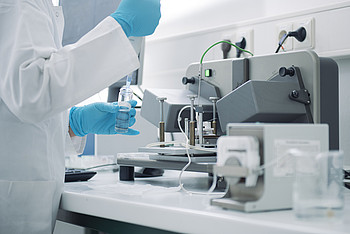
NMR Spectroscopy

NMR Spectroscopy

Contact: Dr. Martin Geisler

  • 1H, 13C, 19F and hetero-nuclear NMR spectroscopy for structure characterization of soluble polymers and small substances (1D and 2D NMR methods)
  • 1H and 13C HRMAS NMR spectroscopy for the characterization of swellable substances (1D and 2D NMR methods)
Thermal Analysis

Thermal Analysis

Contact: Dr. S. Boye

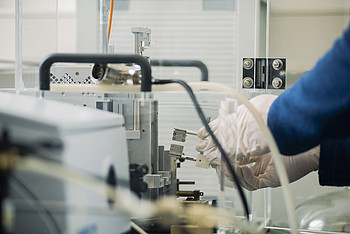
We apply Thermal Analysis in order to study physical and chemical properties of different types of molecules such as polymers, anorganic compounds, etc.

Thermogravimetric investigations (TGA) of polymers are performed to study thermal and thermo-oxidative degradation.

Furthermore, volatile compounds can be analyzed by coupled FTIR spectroscopy and GC-MS.

Dynamic differential calorimetry (DSC) is applied for the investigation of melting, crystallization and glass transition behavior as well as solid-solid phase transitions and cross-linking reactions in polymers.
Chromatography, Fractionation and Light Scattering

Chromatography, Fractionation and Light Scattering

Contact: Prof. A. Lederer

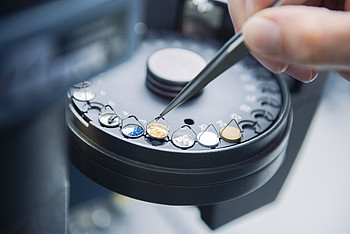
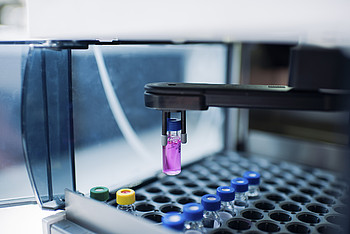
High and ambient temperature size exclusion chromatography (SEC) is performed for determination of molar mass distributions in organic and aqueous media.

Light scattering and viscosity detection, in batch or on-line for absolute enable the determination of:

  • molar masses,
  • dimensions,
  • conformations,
  • and thermodynamic parameters of macromolecules, nanoparticles and conjugates.

Asymmetrical flow field flow fractionation (AF4) and thermal field flow fractionation (thFFF) is applied for the separation and characterization of polymers and macromolecules in the range of 101 – 106 kg/mol.

Classical, head-space and pyrolysis gas chromatography (GC) coupled with mass spectrometry is applied for qualitative determination of volatile compounds.

Vibrational Spectroscopy

Vibrational Spectroscopy

Contact: Dr. D. Fischer (Raman) and Dr. M. Malanin (FTIR)

  • FTIR and Raman spectroscopy for qualitative and quantitative polymer analysis
  • FTIR and Raman microscopy for characterization of additives, contaminations and inclusions as well as analysis of heterogenic materials
  • Confocal Raman microscopy for analysis of polymers, copolymers, materials, depth profiles, 3D analyses, surfaces structures and phase separations
  • Particle analysis in the range from 1 µm up to cm
  • FTIR and Raman imaging
  • In-situ and temperature dependent FTIR and Raman microscopy
  • Surface enhanced Raman spectroscopy (SERS)
  • IR measurements at nanoscale (AFM-IR)
Spectroscopic Ellipsometry

Spectroscopic Ellipsometry

Contact: Dr. E. Bittrich

Ellipsometry in the visible light range is used to determine nm-thin film thicknesses and optical properties in the dry state and in aqueous solutions.

This can be used to analyse the swelling of polymer films, the adsorption of biomolecules, temperature-dependent phase transitions and anisotropic semiconducting thin films for OPV and OLED.

Mueller matrix ellipsometry and microscopy is applied to evaluate biaxial optical anisotropy, e.g. in stretched elastomers or hybrid nanostructures.

Matrix-assisted laser desorption ionization mass spectrometry (MALDI-ToF-MS)