

Programmable Molecular Switching and Electronic Properties
Speaker
Introduction
The Programmable Molecular Switching and Electronic Properties group investigates how molecular-scale changes can be translated into collective structural, mechanical, transport, and electronic behavior. Using quantum-chemical, atomistic, and multiscale simulations, we study molecular switches in polymers, self-assembled systems, interfaces, and surface-bound architectures. Our research follows the pathway from molecular switching and reconfiguration to collective response, electronic-property modulation, information transfer, and molecular programming. We aim to uncover the physical mechanisms by which local conformational or electronic changes propagate across scales and can be used to control organization, transport, mechanical response, and electronic function. Our long-term goal is to establish molecular switching as a design principle for programmable functional materials.
Cooperation
- Dr. Anton Kiriy, IPF Dresden
Topics
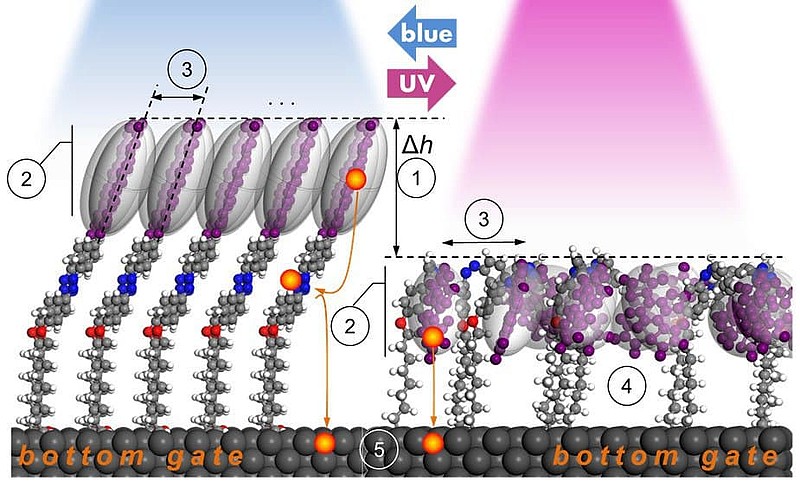
Optically Reconfigurable Nanoscale Junctions for Organic Electronics
(People: Olga Guskova and Vladyslav Savchenko)
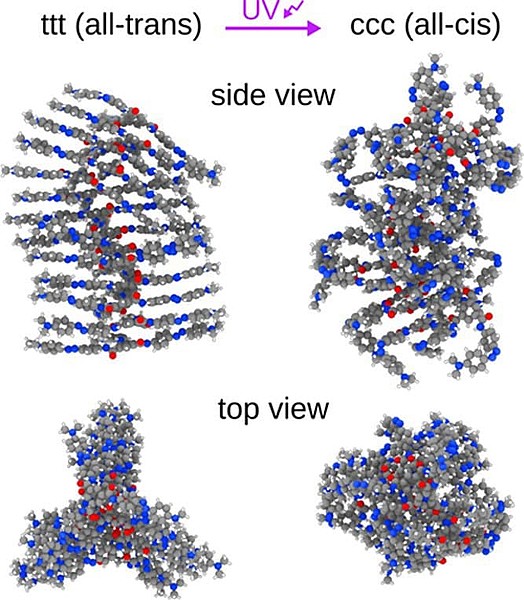
Building Blocks for Organic Electronics and Light-Responsive Materials
(People: Olga Guskova and Markus Koch)
Highlights
- J.-K. Li, M.-Y. Shao, Z.-Y. Yang, O. Guskova
The merging mechanisms of poly(3-hexylthiophene) domains revealed through scanning tunneling microscopy and molecular dynamics simulations
Polymer 191 (2020) 122266 - V. Savchenko, M. Koch, A. S. Pavlov, M. Saphiannikova, O. Guskova
Stacks of Azobenzene Stars: Self-Assembly Scenario and Stabilising Forces Quantified in Computer Modelling
Molecules 24(23) (2019) 4387 - M. Koch, M. Saphiannikova, O. Guskova
Do Columns of Azobenzene Stars Disassemble under Light Illumination?
Langmuir 35(45) (2019) 14659-14669 - D. Raychev, R. D. Méndez-López, A. Kiriy, G. Seifert, J.-U. Sommer, O. Guskova
Copolymers of Diketopyrrolopyrrole and Benzothiadiazole: Design and Function from Simulations with Experimental Support
Macromolecules 52(3) (2019) 904-914
Funding
- DFG, Project GU1510/5-1