

News
Researchers from Tel Aviv University and IPF Develop Peptide-Glycosaminoglycan Hydrogels to Create a Programmable Niche for Blood Stem Cells
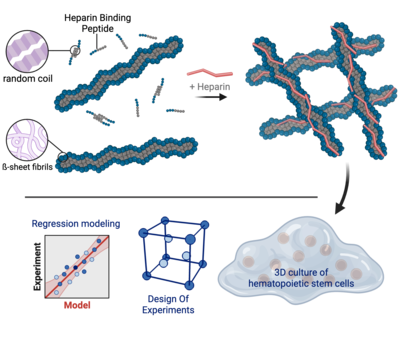
A research team from Tel Aviv University and the IPF, led by Ayala Lampel and Carsten Werner, has developed a peptide-glycosaminoglycan hydrogel system that creates a programmable niche for hematopoietic stem and progenitor cells (HSPCs). The system mimics key biochemical and mechanical cues of the bone marrow microenvironment, enabling researchers to investigate how these signals influence stem cell behavior.
Published in Advanced Functional Materials, the study addresses a central challenge in ex vivo HSPC culture: expanding the cells while preserving stem cell properties relevant to therapeutic applications. The researchers demonstrated that the degree of sulfation in heparin-derived glycosaminoglycans regulates the self-assembly of peptide networks, allowing precise tuning of the hydrogel architecture without requiring covalent crosslinking. By varying the sulfation level, the team could independently adjust the hydrogels' mechanical stiffness and cytokine-binding capacity. The resulting tunable 3D niche provides a system for examining how biochemical and mechanical properties of the cellular microenvironment influence HSPC behavior.
Beyond HSPCs, the sulfation-cofactor principle could be adapted to other niche-dependent cell types, highlighting the potential of these hydrogel systems for applications across various biomedical fields.
The full study is openly accessible at: https://doi.org/10.1002/adfm.77603
22.08.2026