

Wetting of Chromatin Condensates at Heterogeneous Nuclear Boundaries
Methods: Molecular dynamics simulations, Statistical Physics, Computational modeling
The spatial organization of chromosomes (chromatin) inside the cell nucleus is closely linked to gene regulation and cellular function. Recent theoretical studies suggest that chromatin localization near the nuclear envelope can emerge from an interplay between liquid-liquid phase separation and interactions between chromatin-binding proteins and the nuclear boundary [1].
Existing models typically assume a homogeneous nuclear boundary, such that all regions of the nuclear envelope interact equally with chromatin-binding proteins. However, biological interfaces, including the nuclear envelope, are rarely homogeneous. Spatial variations in composition create regions with different affinities for chromatin-binding proteins, potentially influencing chromatin localization and condensate formation. How such heterogeneity affects chromosome organization remains largely unexplored.
The aim of this project is to investigate how spatially heterogeneous nuclear boundaries affect the localization and stability of chromatin condensates. Using coarse-grained molecular dynamics simulations, heterogeneous surface interactions will be introduced into an existing chromatin–protein model and their influence on chromatin organization will be systematically analyzed.
Particular attention will be paid to the following questions:
1. How large must an attractive surface patch be to anchor a chromatin condensate?
2. How does condensate localization depend on the strength of local surface interactions?
3. Can multiple attractive patches lead to distinct condensate locations, or do they promote the formation of a single larger condensate depending on their separation?
The key tasks of the project are listed below:
1. Literature study and familiarization with the simulation framework.
2. Reproduction of reference simulations with homogeneous boundaries.
3. Implementation of heterogeneous boundary interactions.
4. Investigation of chromatin localization for different surface patterns and interaction strengths.
The project offers hands-on experience with molecular dynamics simulations and quantitative analysis of complex biological systems.
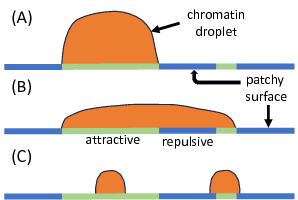
Figure 1: Schematic illustration of a chromatin condensate interacting with a heterogeneous nuclear boundary. Attractive and repulsive surface regions are shown in green and blue, respectively. Panels (A)–(C) illustrate selected possible localization scenarios that may emerge from the interplay between condensate size and the characteristic length scale of surface heterogeneity.
Keywords: Chromatin organization, Biomolecular condensates, Polymer-assisted condensation
References:
[1] J.-U. Sommer, H. Merlitz, and H. Schiessel, Polymer- assisted condensation: A mechanism for hetero-chromatin formation and epigenetic memory, Macromolecules 55, 4841 (2022).
[2] A. Majee and J.-U. Sommer, Polymer-assisted condensation as key to chromatin localization, bioRxiv 10.1101/2025.06.11.658974 (2025). https://journals.aps.org/pre/abstract/10.1103/PhysRevE.94.042407