

News
Stretching Chiral Molecules Amplifies Chiral Optical Response in Gold Nanoparticle Assemblies
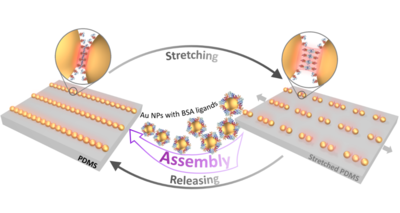
A research team from three divisions of the IPF, together with international collaborators, has demonstrated how to amplify and reversibly control the chiral optical response of gold nanoparticle assemblies. The study, led at the IPF by Dr. Ziwei Zhou and Professor Andreas Fery, was published in Nature Materials.
Chirality, often described as molecular “handedness,” refers to structures that cannot be superimposed on their mirror images. While natural biomolecules typically exhibit only weak optical activity, harnessing their chirality to generate strong optical responses in artificial nanomaterials remains a challenge. To address this, the researchers assembled protein-coated gold nanoparticles into ordered chains on a stretchable polymer substrate. Although the nanoparticle assemblies themselves are not geometrically chiral, the proteins induce a distinct chiral optical response. Mechanical stretching was found to amplify this response by up to 22-fold, despite the increasing distance between individual nanoparticles.
To explain this unexpected enhancement, the team combined advanced optical and infrared spectroscopy with molecular dynamics simulations and electromagnetic modelling. The results indicate that stretching allows the compressed proteins between the nanoparticles to partially recover their secondary structure while altering the alignment of their dipoles. Both effects contribute to the enhanced chiral optical response. Notably, the response remained reversible over more than 100 stretching–relaxation cycles.
The protein layer can be removed and replaced without destroying the nanoparticle assemblies, potentially enabling reusable and adaptive optical materials. The findings may also contribute to future developments in nanophotonics and biosensing.
Original publication:
Zhou, Z., Sun, N., Tverdokhleb, N. et al. Efficient and reversible chirality induction between protein and achiral plasmonic assemblies. Nature Materials 25, 1230–1238 (2026).
https://doi.org/10.1038/s41563-026-02586-7
01.11.2026