

News
IPF Researchers Develop Data-Driven Biomaterials to Guide Cancer Organoid States
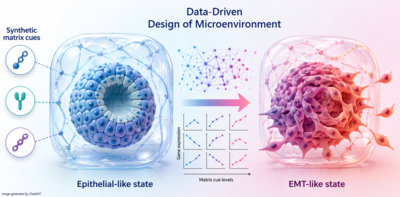
Understanding and controlling how cancer cells transition between different states remains a critical challenge in tumor biology. In a recent publication in Advanced Materials, researchers from the Leibniz Institute of Polymer Research Dresden (IPF) present a data-driven strategy to guide these transitions using engineered biomaterials.
Patient-derived organoids (PDOs) are genetically faithful, scalable models that preserve key tumor features, including tissue architecture and cellular heterogeneity. These miniature tumor systems can self-organize in response to environmental signals, creating opportunities to steer their behavior through modifications in their microenvironment. Unlike most current approaches that rely on genetic manipulation, engineering the organoid microenvironment offers a non-genetic strategy to regulate cell-state transitions and phenotypic plasticity.
Dr. Ali Nadernezhad and colleagues developed a data-driven platform to design biomaterials capable of influencing the transcriptional states of pancreatic cancer organoids. Using synthetic bioactive cues, they systematically explored different formulations of star-shaped polyethylene glycol (PEG) hydrogels functionalized with bioactive peptides. By correlating hydrogel composition with gene-expression responses, the team established a framework for predicting and directing organoid cell states.
In a proof-of-concept study conducted in collaboration with Professor Daniel E. Stange from the Universitätsklinikum Carl Gustav Carus Dresden, the researchers demonstrated that donor-derived organoids could be shifted toward an epithelial-to-mesenchymal transition (EMT)-like state, a process closely associated with cancer progression and metastasis. These findings highlight the potential of engineered biomaterials to direct complex cellular behaviors in tunable organoid systems, with potential implications for cancer biology, regenerative medicine, and biomaterials research.
This work was funded by the European Union through the ERC Consolidator Grant CHIPIN awarded to Professor Daniela Lössner.
21.05.2026