

News
IPF Researchers Create Olympic Gels, a Long-Theorized Class of DNA-Based Soft Materials
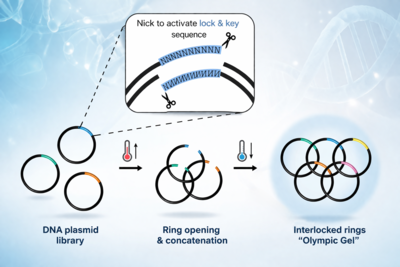
An interdisciplinary research team led by Dr. Elisha Krieg at the Leibniz Institute of Polymer Research Dresden (IPF) has successfully synthesized and characterized Olympic gels, a long-theorized class of soft materials. Unlike conventional gels, which are held together by chemical crosslinks, Olympic gels derive their structural stability from the mechanical interlocking of ring-shaped molecules, similar to chain mail.
First proposed in 1979, the realization of Olympic gels has remained challenging due to the complexity of their topology. Elisha Krieg’s team addressed this challenge by combining methods from synthetic biology, DNA nanotechnology, and polymer physics, supported by computer simulations carried out by the IPF group of Dr. Michael Lang.
The key innovation was the creation of a library of more than 16,000 distinct DNA rings, each equipped with unique molecular “lock-and-key” sequences. Upon enzymatic activation, the rings preferentially close onto themselves rather than linking with neighboring molecules—a critical requirement for forming the interlocked network characteristic of Olympic gels. The resulting material exhibits mechanical properties and swelling behavior that differ markedly from those of conventional polymer networks, confirming long-standing predictions in polymer theory.
Beyond its significance as a model system for fundamental materials research, Olympic gels hold promise for a range of applications. These include artificial microreactors for targeted drug delivery, advanced model systems for studying DNA organization in microorganisms such as Kinetoplastea, and the development of highly stretchable filtration membranes. More broadly, the work demonstrates how extreme compositional complexity, a hallmark of biological systems, can serve as a design principle for creating materials with novel and emergent properties.
15.04.2026