

Starlike polymer brushes
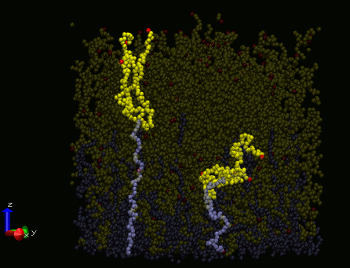
Brushes can be made of polymers that have complex architectures, such as dendrimers. Such brushes are expected to exhibit particular mechanical and dynamical properties, like elasticity or response to shear. The starlike polymer is a special case of dendridic polymers. In our simulations, we have analyzed brushes made of these starlike polymers, by grafting a single arm to the substrate. One interesting feature of these brushes is the existence of two polulations, one of which containing strongly stretched polymers, another one retreated, partially collapsed polymers. Despite of these complications, fundamental scaling properties that were derived for linear-chain brushes have been shown to remain valid for starlike polymer brushes. Single polymers can flip between up- and down populations. We have analyzed the kinetics of these flipping events and, by modifying the grafting density, found that the rates are exponentially suppressed with the chain stretching potential, an indication for the chain tension being an activation barrier for that reaction.
Highlights:
- Holger Merlitz, Chen-Xu Wu, and Jens-Uwe Sommer
Starlike Polymer Brushes
Macromolecules 44, 7043 (2011)